December 7, 2015

New approaches for hybrid solar cells


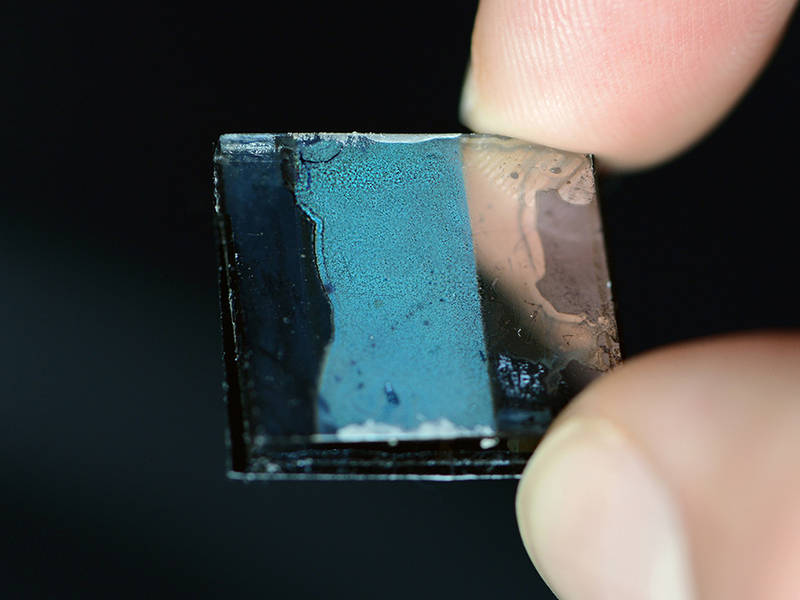
Filled with suitable organic polymers the highly porous germanium nanofilm becomes
a hybrid solar cell – Photo: Andreas Battenberg

Nanostructured germanium for portable photovoltaics and battery electrodes

(December 7, 2015)  Using a new procedure researchers at the Technical University of Munich (TUM) and the Ludwig Maximillians University of Munich (LMU) can now produce extremely thin and robust, yet highly porous semiconductor layers. A very promising material – for small, light-weight, flexible solar cells, for example, or electrodes improving the performance of rechargeable batteries.

The coating on the wafer that Professor Thomas Fässler, chair of Inorganic Chemistry with a Focus on Novel Materials at TU Munich, holds in his hands glitters like an opal. And it has amazing properties: It is hard as a crystal, exceptionally thin and – since it is highly porous – light as a feather.

Electronmicroscopical image of the germanium-structure after removal
of the polymer templates – Image: Katia Rodewald / TUM

By integrating suitable organic polymers into the pores of the material, the scientists can custom tailor the electrical properties of the ensuing hybrid material. The design not only saves space, it also creates large interface surfaces that improve

“You can imagine our raw material as a porous scaffold with a structure akin to a honeycomb. The walls comprise inorganic, semiconducting germanium, which can produce and store electric charges. Since the honeycomb walls are extremely thin, charges can flow along short paths,” explains Fässler.


journal reference >>

The world’s tiniest temperature sensor is powered by radio waves


The tiny sensor on the finger of PhD-student Hao Gao. Photo: Bart van Overbeeke.

(December 7, 2015)  Researchers at TU/e have developed a very tiny wireless temperature sensor that is powered in a very special way: from the radio waves that are part of the sensor’s wireless network. This means that the sensor needs not even a single wire, nor a battery that would have to be replaced. The arrival of such sensors is an important development on route towards smart buildings, for instance. But the applications are many and various.

The smart buildings of the future will be full of sensors that will respond to the residents’ every need, and will be as sustainable as possible. Like heating and lighting that only switches on when someone is in the room. That’s only possible if these sensors are wireless and need no batteries, otherwise in a large building you would have to change the batteries every day. This is  demonstrated by TU/e researcher Hao Gao who will be awarded his PhD on Monday 7 December for his thesis in which he developed a sensor that measures just 2 square millimeters and weights a mere 1.6 milligrams, equivalent to a grain of sand.

read entire press  release >>

Stretchable hydrogel electronics


A new stretchy hydrogel can be embedded with various electronics. Here, a sheet of hydrogel
is bonded to a matrix of polymer islands (red) that can encapsulate electronic components
such as semiconductor chips, LED lights, and temperature sensors. Credit: Melanie Gonick/MIT

(December 7, 2015)  Water-based “Band-Aid” senses temperature, lights up, and delivers medicine to the skin.

MIT engineers have designed what may be the Band-Aid of the future: a sticky, stretchy, gel-like material that can incorporate temperature sensors, LED lights, and other electronics, as well as tiny, drug-delivering reservoirs and channels. The “smart wound dressing” releases medicine in response to changes in skin temperature and can be designed to light up if, say, medicine is running low.

A stretchable, smart, hydrogel wound dressing includes temperature sensors and drug-delivery
channels and reservoirs, embedded in a robust hydrogel matrix. Mock drugs can be released
at various locations on demand, based on the measured temperatures.
Courtesy of the researchers

When the dressing is applied to a highly flexible area, such as the elbow or knee, it stretches with the body, keeping the embedded electronics functional and intact.

The key to the design is a hydrogel matrix designed by Xuanhe Zhao, the Robert N. Noyce Career Development Associate Professor in MIT’s Department of Mechanical Engineering. The hydrogel, which Zhao detailed earlier this month, is a rubbery material, mostly composed of water, designed to bond strongly to surfaces such as gold, titanium, aluminum, silicon, glass, and ceramic.

In a new paper published in the journal Advanced Materials, the team reports embedding various electronics within the hydrogel, such as conductive wires, semiconductor chips, LED lights, and temperature sensors. Zhao says electronics coated in hydrogel may be used not just on the surface of the skin but also inside the body, for example as implanted, biocompatible glucose sensors, or even soft, compliant neural probes.

“Electronics are usually hard and dry, but the human body is soft and wet. These two systems
have drastically different properties,” says professor Xuanhe Zhao (pictured here).
Credit: Melanie Gonick/MIT

“Electronics are usually hard and dry, but the human body is soft and wet. These two systems have drastically different properties,” Zhao says. “If you want to put electronics in close contact with the human body for applications such as health care monitoring and drug delivery, it is highly desirable to make the electronic devices soft and stretchable to fit the environment of the human body. That’s the motivation for stretchable hydrogel electronics.”

Zhao’s co-authors on the paper are graduate students Shaoting Lin, Hyunwoo Yuk, German Alberto Parada, postdoc Teng Zhang, Hyunwoo Koo from Samsung Display, and Cunjiang Yu from the University of Houston.

A strong and stretchy bond

Typical synthetic hydrogels are brittle, barely stretchable, and adhere weakly to other surfaces.

“They’re often used as degradable biomaterials at the current stage,” Zhao says. “If you want to make an electronic device out of hydrogels, you need to think of long-term stability of the hydrogels and interfaces.”

To get around these challenges, his team came up with a design strategy for robust hydrogels, mixing water with a small amount of selected biopolymers to create soft, stretchy materials with a stiffness of 10 to 100 kilopascals — about the range of human soft tissues. The researchers also devised a method to strongly bond the hydrogel to various nonporous surfaces.

In the new study, the researchers applied their techniques to demonstrate several uses for the hydrogel, including encapsulating a titanium wire to form a transparent, stretchable conductor. In experiments, they stretched the encapsulated wire multiple times and found it maintained constant electrical conductivity.

read entire press  release >>

December 5, 2015

Oregon researchers shed new light on solar water-splitting process


Image courtesy of Fuding Lin and Shannon Boettcher
To one day design cells that mimic trees ability to turn sunlight and water into fuel, scientists
at the University of Oregon devised a new technique that allows them to “see” a key interface
in the cells – the interface between the semiconductor that absorbs sunlight and generates
electricity with the catalyst that uses the electricity to create fuel.

(December 5, 2015)  With the help of a new method called "dual-electrode photoelectrochemistry," University of Oregon scientists have provided new insight into how solar water-splitting cells work. An important and overlooked parameter, they report, is the ion-permeability of electrocatalysts used in water-splitting devices.

Their discovery could help replace a trial-and-error approach to paring electrocatalysts with semiconductors with an efficient method for using sunlight to separate hydrogen and oxygen from water to generate renewable energy, says Shannon W. Boettcher, professor of chemistry and head of the Solar Materials and Electrochemistry Laboratory in the UO's Materials Science Institute.


The research is described in a paper placed online Dec. 1 in advance of regular publication in the journal Nature Materials.

Solar water-splitting cells, which mimic photosynthesis, require at least two different types of materials: a semiconductor that absorbs sunlight and generates excited electrons and an electrocatalyst, typically a very thin film of a metal oxide that contains elements such as nickel, iron and oxygen, which serves to accelerate the rate at which electrons move on and off water molecules that are getting split into hydrogen and oxygen.


read entire press release (DoE) >>

The Self-Catering Houseboat


Building design of a floating house that provides its own heat and water.
© Fraunhofer IVI

(December 5, 2015)  A life away from traffic noise and exhaust fumes – more and more people are drawn to water. Energy self-sufficient floating homes not only fulfill the criterion for this new lifestyle, they can also boost economy. Medium-sized companies, manufacturers, universities as well as two Fraunhofer Institutes work hand-in-hand on the autartec® project.

Floating homes are becoming increasingly popular in Germany – not only as holiday homes, but also as permanent residences. The Lusatian Lake District (Lausitzer Seenland) is particularly suitable for such a lifestyle: with its 23 lakes and a surface area of over 32 000 acres, it is the largest artificial lake district in Europe. Over decades, the region, which is located between the German states Saxony and Brandenburg, had been characterized by open-cast lignite coal mining. In the coming years, this way of life of living on water will help enhance the region’s attractiveness and boost its economy.

This is also the objective of the Lusatian autartec® project, which the two Fraunhofer Institutes based in Dresden, the Fraunhofer Institute for Transportation and Infrastructure Systems (IVI) and the Fraunhofer Institute for Ceramic Technologies and Systems (IKTS), are involved in, as well as other partners from the region such as medium-size companies, manufacturers, the Technical University of Dresden (TUD) and the Technical University of Brandenburg (BTU). They will all work hand in hand to build a floating home on Lake Geierswalde, to the northwest of the city of Hoyerswerda, by 2017. This floating home will not only look elegant, it will also be able to provide for its own water, electricity and heat. “These kinds of energy self-sufficient floating homes do not exist yet,“ says autartec® project coordinator Professor Matthias Klingner of IVI. Many lakes in the Lusatian Lake District are cut off from infrastructure such as water and energy supply. “We want to find a solution for this kind of environment,“ says Klingner.

read entire press  release >>

Electric cars: batteries with brains


Intelligent cell of the Fraunhofer IPA: A microcontroller records physical parameters
such as temperature and state of charge. If a cell is empty, it switches itself off automatically.
© Fraunhofer IPA

(December 5, 2015)  The battery is the heart of the electric car. Fraunhofer researchers have developed an energy storage device which is significantly more cost-effective over the entire life cycle in comparison with previous models. If one of the more than one hundred battery cells is defective, it can be replaced easily. Until now, the entire battery had to be replaced.

The core of electric cars are their batteries. So far, these have been monolithic blocks in which the individual battery cells as well as the necessary technology have been housed. All individual cells should theoretically be able to save the same amount of energy. In practice, though, this is somewhat different: due to production reasons, their capacities vary. This is problematic, since the cells are connected in series. The entire battery is therefore only as strong as its weakest cell. If this cell is “empty”, the remaining energy in the other battery cells does not help – the car has to be recharged. For that reason, manufacturers presort and install cells of a similar capacity into a battery. Since some cells are sorted out as a result of this process, and this pushes the price of the batteries up. Another shortcoming is that when a cell is defective, the vehicle stops functioning. That means that the entire energy storage device has to be replaced.

read entire press  release >>

GM mice reveal the secret to a painless life


(December 5, 2015)  People born with a rare genetic mutation are unable to feel pain, but previous attempts to recreate this effect with drugs have had surprisingly little success. Using mice modified to carry the same mutation, UCL researchers funded by the MRC and Wellcome Trust have now discovered the recipe for painlessness.

‘Channels’ that allow messages to pass along nerve cell membranes are vital for electrical signalling in the nervous system. In 2006, it was shown that sodium channel Nav1.7 is particularly important for signalling in pain pathways and people born with non-functioning Nav1.7 do not feel pain. Drugs that block Nav1.7 have since been developed but they had disappointingly weak effects.

The new study, published in Nature Communications, reveals that mice and people who lack Nav1.7 also produce higher than normal levels of natural opioid peptides.

To examine if opioids were important for painlessness, the researchers gave naloxone, an opioid blocker, to mice lacking Nav1.7 and found that they became able to feel pain. They then gave naloxone to a 39-year-old woman with the rare mutation and she felt pain for the first time in her life.

“After a decade of rather disappointing drug trials, we now have confirmation that Nav1.7 really is a key element in human pain,” says senior author Professor John Wood (UCL Medicine). “The secret ingredient turned out to be good old-fashioned opioid peptides, and we have now filed a patent for combining low dose opioids with Nav1.7 blockers. This should replicate the painlessness experienced by people with rare mutations, and we have already successfully tested this approach in unmodified mice.”

Broad-spectrum sodium channel blockers are used as local anaesthetics, but they are not suitable for long-term pain management as they cause complete numbness and can have serious side-effects over time. By contrast, people born without working Nav1.7 still feel non-painful touch normally and the only known side-effect is the inability to smell.


journal reference (Open Access) >>

NEUROSCIENTISTS NOW CAN READ THE MIND OF A FLY


(December 5, 2015)  New technique could yield knowledge useful to understanding the human brain.

Northwestern University neuroscientists now can read the mind of a fly. They have developed a clever new tool that lights up active conversations between neurons during a behavior or sensory experience, such as smelling a banana. Mapping the pattern of individual neural connections could provide insights into the computational processes that underlie the workings of the human brain.

In a study focused on three of the fruit fly’s sensory systems, the researchers used fluorescent molecules of different colors to tag neurons in the brain to see which connections were active during a sensory experience that happened hours earlier.

Synapses are points of communication where neurons exchange information. The fluorescent labeling technique is the first to allow scientists to identify individual synapses that are active during a complex behavior, such as avoiding heat. Better yet, the fluorescent signal persists for hours after the communication event, allowing researchers to study the brain’s activity after the fact, under a microscope.

“Much of the brain’s computation happens at the level of synapses, where neurons are talking to each other,” said Marco Gallio, who led the study. “Our technique gives us a window of opportunity to see which synapses were engaged in communication during a particular behavior or sensory experience. It is a unique retrospective label.”


journal reference (Open Access) >>

NEW WAY TO MAKE YEAST HYBRIDS MAY INSPIRE NEW BREWS, BIOFUELS


(December 5, 2015)  About 500 years ago, the accidental natural hybridization of Saccharomyces cerevisiae, the yeast responsible for things like ale, wine and bread, and a distant yeast cousin gave rise to lager beer.

Today, cold-brewed lager is the world's most consumed alcoholic beverage, fueling an industry with annual sales of more than $250 billion.

The first lagers depended on the serendipitous cross of Saccharomyces species as evolutionarily diverse as humans and chickens. The result, however, yielded a product of enormous economic value, demonstrating the latent potential of interspecies yeast hybrids. In nature, the odds of a similar hybridization event are, conservatively, one in a billion.

Now, thanks to a new method for making interspecies yeast hybrids in the lab, the makers of beer, wine, biofuels and other products that depend on yeasts may soon have many more strains of the microorganism to work with.

"We can achieve hybrids at rates of one in a thousand cells," notes William Alexander, a University of Wisconsin-Madison postdoctoral research associate and the lead author of a paper describing the new method in a special synthetic biology issue of the journal Fungal Genetics and Biology. "It is much more efficient than nature."


There are hundreds of known species of yeasts and they occupy almost every ecological niche imaginable worldwide. They are essential to the process of fermentation, where the microbes convert sugars to alcohol and carbon dioxide. Yeasts are used widely to not only make beer, wine and bread, but also cider, whiskey, cheese, yogurt, soy sauce and an array of other fermented foods and beverages. In industry, yeasts are used to produce biofuels and to make enzymes, flavors and pigments and even drugs such as human insulin.

read entire press  release >>

Storing electricity in paper


Researchers at Linköping University’s Laboratory of Organic Electronics, Sweden,
have developed power paper – a new material with an outstanding ability to store
energy. The material consists of nanocellulose and a conductive polymer.
The results have been published in Advanced Science.

(December 5, 2015)  One sheet, 15 centimetres in diameter and a few tenths of a millimetre thick can store as much as 1 F, which is similar to the supercapacitors currently on the market. The material can be recharged hundreds of times and each charge only takes a few seconds.

It’s a dream product in a world where the increased use of renewable energy requires new methods for energy storage – from summer to winter, from a windy day to a calm one, from a sunny day to one with heavy cloud cover.

”Thin films that function as capacitors have existed for some time. What we have done is to produce the material in three dimensions. We can produce thick sheets,” says Xavier Crispin, professor of organic electronics and co-author to the article just published in Advanced Science.


Other co-authors are researchers from KTH Royal Institute of Technology, Innventia, Technical University of Denmark and the University of Kentucky.

The material, power paper, looks and feels like a slightly plasticky paper and the researchers have amused themselves by using one piece to make an origami swan – which gives an indication of its strength.

The structural foundation of the material is nanocellulose, which is cellulose fibres which, using high-pressure water, are broken down into fibres as thin as 20 nm in diameter. With the cellulose fibres in a solution of water, an electrically charged polymer (PEDOT:PSS), also in a water solution, is added. The polymer then forms a thin coating around the fibres.


journal reference (Open Access)  >>

Nanoscale drawbridges open path to color displays


CAPTION: This animation illustrates the markedly different colors of light that are scattered
thanks to plasmonic shifts that occur when no metal bridges are present (left) and when
they are (right). CREDIT: C. Byers/Rice University

(December 5, 2015)  Rice develops first method for reversible color changes with metal nanoparticles.

A new method for building “drawbridges” between metal nanoparticles may allow electronics makers to build full-color displays using light-scattering nanoparticles that are similar to the gold materials that medieval artisans used to create red stained-glass.

“Wouldn’t it be interesting if we could create stained-glass windows that changed colors at the flip of a switch?” said Christy Landes, associate professor of chemistry at Rice and the lead researcher on a new study about the drawbridge method that appears this week in the open-access journal Science Advances.

CAPTION: This electron microscope image shows a dimer of silver plated
gold nanoparticles. A layer of silver connects the particles. CREDIT: C. Byers/Rice University

The research by Landes and other experts at Rice University’s Smalley-Curl Institute could allow engineers to use standard electrical switching techniques to construct color displays from pairs of nanoparticles that scatter different colors of light.

For centuries, stained-glass makers have tapped the light-scattering properties of tiny gold nanoparticles to produce glass with rich red tones. Similar types of materials could increasingly find use in modern electronics as manufacturers work to make smaller, faster and more energy-efficient components that operate at optical frequencies.

Though metal nanoparticles scatter bright light, researchers have found it difficult to coax them to produce dramatically different colors, Landes said.

This animation illustrates the green and orange hues of light that are scattered thanks
to plasmonic shifts that occur when metal bridges are present (bottom) and
when they are not (top). Credit: C. Byers/Rice University

Rice’s new drawbridge method for color switching incorporates metal nanoparticles that absorb light energy and convert it into plasmons, waves of electrons that flow like a fluid across a particle’s surface. Each plasmon scatters and absorbs a characteristic frequency of light, and even minor changes in the wave-like sloshing of a plasmon shift that frequency. The greater the change in plasmonic frequency, the greater the difference between the colors observed.


journal reference (Open Access) >>

Micro-map of hippocampus lends big hand to brain research


(December 5, 2015)  Researchers at The Neuro compile new tool designed to be shared with experts world-wide to accelerate research.

A new detailed map of the hippocampal region of the brain, compiled by researchers at the Montreal Neurological Institute and Hospital-The Neuro at McGill University, is helping the scientific community accelerate research and develop better treatments for patients suffering from epilepsy and other neurological and psychiatric disorders.

The team of researchers, led by Dr. Neda Bernasconi, aneuroscientist specializing in the neuroimaging of epilepsy and co-founder of the Neuroimaging of Epilepsy Laboratory (NOEL) at The Neuro, set out to build and share a detailed model of the substructures making up one of the key centres of the brain involved in epilepsy: the hippocampus. The goal of their project, published on November 10 inScientific Data, is to improve the tools available to researchers and clinicians working in the field around the globe.

Epilepsy is a neurological disorder characterized by a sudden, brief change in the brain, expressed as a seizure. According to Epilepsy Canada, approximately one percent of Canadians suffer from the condition and more than 30% of patients with epilepsy do not respond to anti-epileptic drugs. For these individuals, the surgical removal of the brain tissue causing seizures is the only known effective treatment for controlling the condition and improving quality of life.


journal reference (Open Access)  >>

Penn Researchers Make Thinnest Plates That Can Be Picked Up by Hand


The researchers' plates are strong enough to be picked up by hand and retain
their shape after being bent and squeezed.

(December 5, 2015)  Scientists and engineers are engaged in a global race to make new materials that are as thin, light and strong as possible. These properties can be achieved by designing materials at the atomic level, but they are only useful if they can leave the carefully controlled conditions of a lab.

Researchers at the University of Pennsylvania have now created the thinnest plates that can be picked up and manipulated by hand.

Despite being thousands of times thinner than a sheet of paper and hundreds of times thinner than household cling wrap or aluminum foil, their corrugated plates of aluminum oxide spring back to their original shape after being bent and twisted. 

Like cling wrap, comparably thin materials immediately curl up on themselves and get stuck in deformed shapes if they are not stretched on a frame or backed by another material.

Being able to stay in shape without additional support would allow this material, and others designed on its principles, to be used in aviation and other structural applications where low weight is at a premium.

The hexagonal corrugation of the plates is responsible
for their stiffness and strength.

The study was led by Igor Bargatin, the Class of 1965 Term Assistant Professor of Mechanical Engineering and Applied Mechanics in Penn’s School of Engineering and Applied Science, along with lab member Keivan Davami, a postdoctoral scholar, and Prashant Purohit, an associate professor of mechanical engineering. Bargatin lab members John Cortes and Chen Lin, both graduate students; Lin Zhao, a former student in Engineering’s nanotechnology master’s program; and Eric Lu and Drew Lilley, undergraduate students in the Vagelos Integrated Program in Energy Research, also contributed to the research.

They published their findings in the journal Nature Communications. 

“Materials on the nanoscale are often much stronger than you’d expect, but they can be hard to use on the macroscale” Bargatin said. “We’ve essentially created a freestanding plate that has nanoscale thickness but is big enough to be handled by hand. That hasn’t been done before.”


journal reference (Open Access) >>

More efficient way of converting ethanol leads to better alternative fuel


New Catalysts Lead to Near Total Conversion

(December 5, 2015)  Ethanol, which is produced from corn, is commonly-used as an additive in engine fuel as a way to reduce harmful emissions and scale back U.S. reliance on foreign oil.  But since ethanol is an oxygenated fuel, its use results in a lower energy output, as well as increased damage to engines via corrosion.

But now a research team, led by William Jones at the University of Rochester, has developed a series of reactions that results in the selective conversion of ethanol to butanol, without producing unwanted byproducts.

“Butanol is much better than ethanol as an alternative to gasoline,” said Jones, the C.F. Houghton Professor of Chemistry. “It yields more energy, is less volatile, and doesn’t cause damage to engines.”

In fact, Jones was able to increase the amount of ethanol converted to butanol by almost 25 percent over currently used methods. Jones describes his process in a paper just published in the Journal of the American Chemical Society.

Converting ethanol to butanol involves creating a larger chemical molecule with more carbon and hydrogen atoms.  Although both molecules have a single oxygen atom, the higher carbon-to-oxygen ratio in butanol gives it a higher energy content, while the larger size make it less volatile.

One method of converting the ethanol to butanol is the three-step Guerbet reaction, which involves temporarily giving up hydrogen atoms in an intermediate step, then adding them back in to create the final product. One problem with the Guerbet reaction is that an intermediate product—acetaldehyde—can react with both itself and the butanol product to create unwanted molecules.

Jones modified the Guerbet reaction by using iridium as the initial catalyst and nickel or copper hydroxide, instead of potassium hydroxide (KOH), in the second step. While the best current conditions for the Guerbet reaction convert ethanol to butanol with about 80% selectivity, Jones’ reaction produced butanol in more than 99 percent selectivity.  No undesirable side products are produced.

read entire press  release >>

December 4, 2015

Color of the Year 2016 Pantone


Color of the Year 2016 Pantone:  ROSE QUARTZ & SERENITY

(December 4, 2015) PANTONE 13-1520 & PANTONE 15-3919

A softer take on color for 2016: For the first time, the blending of two shades – Rose Quartz and Serenity are chosen as the PANTONE Color of the Year

As consumers seek mindfulness and well-being as an antidote to modern day stresses, welcoming colors that psychologically fulfill our yearning for reassurance and security are becoming more prominent. Joined together, Rose Quartz and Serenity demonstrate an inherent balance between a warmer embracing rose tone and the cooler tranquil blue, reflecting connection and wellness as well as a soothing sense of order and peace.

The prevalent combination of Rose Quartz and Serenity also challenges traditional perceptions of color association.

source >>

December 2, 2015

Carbon capture analyst: 'Coal should stay in the ground'


(December 2, 2015)  Serious flaws have been found in a decade's worth of studies about the best way to reduce greenhouse gas emissions and stabilize the climate.

The findings, from the University of Michigan, are released as world leaders at COP21 attempt to negotiate the globe's first internationally binding climate agreement.

The U-M researchers have found that most economic analysis of carbon capture and storage, or CCS, technology for coal-fired power plants severely underestimates the technique's costs and overestimates its energy efficiency. CCS involves sucking carbon out of coal-fired power plants' flue gases, compressing it and then injecting it deep underground.

The new analysis puts the cost of reducing carbon emissions with CCS-equipped coal plants higher than any previous study—and most importantly, higher than wind and comparable to solar power. It's the first study to confront the so-called "energy loop" inherent in the CCS process.

Beyond a one-time "energy penalty" these plants pay because they have to burn more coal to power devices that capture carbon, the researchers say the disadvantage compounds until fuel costs leap to four times today's accepted estimates.

read entire press  release >>

New method finds even the tiniest plastics in the sea


Studies have estimated that each year between 4 and 12 million tonnes of plastics end up
in the sea, and that the figure is expected to double over the next ten years. But we have
only begun to learn what happens with the plastics afterwards. Two students on the MSc
programme Aquatic Science and Technology have now developed a method that can measure
the microplastics that other methods overlook.

(December 2, 2015)  Using a filtration system mounted on the stern tube water intake of the marine research vessel Dana, the two students Robin Lenz and Kristina Enders collected microplastics on a route from northern Denmark across the Atlantic to the Sargasso Sea and back again. This enabled researchers from DTU Aqua to determine the volume of plastics in the sea.

“This is the first time that the nearly invisible microplastics have been quantified so comprehensively. And we found microplastics everywhere along the almost 10,000 km long route,” says Professor Torkel Gissel Nielsen, DTU Aqua, co-author of two articles on the collection, which has just been published in Marine Pollution Bulletin:

“There's a lot of focus on plastics in the sea just now, but there are still many unknowns. Therefore, there is a great need to develop new methods to examine the extent of the problem and understand what actually happens with the plastics that end up in the sea. For although plastics are everywhere, we do not find them in the quantities to be expected based on the the large quantities that every year is led out into sea, and the big question is what becomes of it?” asks the professor.


journal reference >>

PPPL physicists propose new plasma-based method to treat radioactive waste


(Photo by U.S. Department of Energy)
Securing a shipment of mixed, low-level waste from Hanford for treatment and disposal.

(December 2, 2015)  Physicists at the U.S. Department of Energy's (DOE) Princeton Plasma Physics Laboratory (PPPL) are proposing a new way to process nuclear waste that uses a plasma-based centrifuge. Known as plasma mass filtering, the new mass separation techniques would supplement chemical techniques.  It is hoped that this combined approach would reduce both the cost of nuclear waste disposal and the amount of byproducts produced during the process.  This work was supported by PPPL's Laboratory Directed Research and Development Program.

"The safe disposal of nuclear waste is a colossal problem," said Renaud Gueroult, staff physicist at PPPL and lead author of the paper that appeared in the Journal of Hazardous Materials in October. "One solution might be to supplement existing chemical separation techniques with plasma separation techniques, which could be economically attractive, ideally leading to a reevaluation of how nuclear waste is processed."

The immediate motivation for safe disposal is the radioactive waste stored currently at the Hanford Site, a facility in Washington State that produced plutonium for nuclear weapons during the Cold War. The volume of this waste originally totaled 54 million gallons and was stored in 177 underground tanks.

Machinery to encase waste in glass

In 2000, Hanford engineers began building machinery that would encase the radioactive waste in glass. The method, known as "vitrification," had been used at another Cold War-era nuclear production facility since 1996. A multibillion-dollar vitrification plant is currently under construction at the Hanford site.

read entire press  release >>

CERAMIC PARTICLES SUPPLY DIGITAL X-RAY PLATES “FROM AN AEROSOL CAN”


Distribution of the ceramic particles in the plastic visualized by
electron microscopy. Source: INM

(December 2, 2015)  Researchers at the INM developed new materials to manufacture X-ray detectors inexpensively and on a large scale with greater image resolution.

Digital X-ray systems have become a vital part of health care. The analog X-ray film of the past has been replaced by digital flat panel detectors. Today’s detectors are sensitive but quite expensive and have limited resolution. Now, scientists collaborating in project HOP-X have succeeded in developing new materials for detectors: they embedded ceramic particles in a conductive plastic. The components of these “composite detectors” can be stirred into a solvent and then applied like paint by spraying. This means that, in future, it might be possible to manufacture X-ray detectors inexpensively and on a large scale with greater image resolution.

X-ray detectors consist of a scintillator layer and a photodiode. The scintillator layer converts X-rays into visible light which the photodiode absorbs. Such detectors are difficult to manufacture and expensive. Their resolution is limited because the signals received can interfere with each other. In order to manufacture X-ray detectors at lower cost, scientists from Siemens Healthcare GmbH, the INM –Leibniz Institute for New Materials, the CAN GmbH, the Universities of Erlangen and further partners took a new approach in the project HOP-X: they used materials developed for flexible solar cells and adapted them to the X-rays.


journal reference >>

December 1, 2015

UW roboticists learn to teach robots from babies


A collaboration between UW developmental psychologists and computer scientists aims to enable
robots to learn in the same way that children naturally do. The team used research on how babies
follow an adult’s gaze to “teach” a robot to perform the same task.University of Washington

(December 1, 2015)  Babies learn about the world by exploring how their bodies move in space, grabbing toys, pushing things off tables and by watching and imitating what adults are doing.

But when roboticists want to teach a robot how to do a task, they typically either write code or physically move a robot’s arm or body to show it how to perform an action.

Now a collaboration between University of Washington developmental psychologists and computer scientists has demonstrated that robots can “learn” much like kids — by amassing data through exploration, watching a human do something and determining how to perform that task on its own.

“You can look at this as a first step in building robots that can learn from humans in the same way that infants learn from humans,” said senior author Rajesh Rao, a UW professor of computer science and engineering.

“If you want people who don’t know anything about computer programming to be able to teach a robot, the way to do it is through demonstration — showing the robot how to clean your dishes, fold your clothes, or do household chores. But to achieve that goal, you need the robot to be able to understand those actions and perform them on their own.”

The research, which combines child development research from the UW’s Institute for Learning & Brain Sciences Lab (I-LABS) with machine learning approaches, was published in a paper in November in the journal PLOS ONE.

This robot used the new UW model to imitate a human moving toy food objects around a tabletop.
By learning which actions worked best with its own geometry, the robot could use different means to
achieve the same goal — a key to enabling robots to learn through imitation.University of Washington

In the paper, the UW team developed a new probabilistic model aimed at solving a fundamental challenge in robotics: building robots that can learn new skills by watching people and imitating them.

The roboticists collaborated with UW psychology professor and I-LABS co-director Andrew Meltzoff, whose seminal research has shown that children as young as 18 months can infer the goal of an adult’s actions and develop alternate ways of reaching that goal themselves.


journal reference (Open Access) >>

Theory of 'smart' plants may explain the evolution of global ecosystems


Princeton University researchers suggest in a new theory of land-biome evolution
that plants are not passive features of their environments, but may instead actively
behave in ways that determine the productivity and composition of their ecosystems.
The theory was developed to explain why trees known as "nitrogen fixers," which produce
their own fertilizer from atmospheric nitrogen, flourish in nitrogen-rich tropical soils,
but are short-lived in the nitrogen-poor soils of boreal or temperate forests. The aerial photo
above shows a rainforest in Panama in which nitrogen-fixing trees are abundant
(about 10 percent of all trees), diverse, and persist in both young and old forests.
The researchers found that tropical nitrogen fixers evolved to stop producing nitrogen
in order to compete with neighboring trees.
(Photo courtesy of Smithsonian Tropical Research Institute, Panama)

(December 1, 2015)  It's easy to think of plants as passive features of their environments, doing as the land prescribes, serving as a backdrop to the bustling animal kingdom.

But what if the ecosystems of the world take their various forms because plant "decisions" make them that way? A new theory presented by Princeton University researchers in the journal Nature Plants suggests that in some cases that may be exactly what happens. In one of the first global theories of land-biome evolution, the researchers write that plants may actively behave in ways that not only benefit themselves but also determine the productivity and composition of their environs.

"Our theory explains biomes based on the new idea that we must consider plants to be smart and strategic," said senior author Lars Hedin, a Princeton professor of ecology and evolutionary biology and department chair. "This is a global theory that explains why biomes differ in nutrient conditions and in their abilities to respond to disturbances and to absorb carbon dioxide from the atmosphere."

The researchers developed their theory to solve a longstanding mystery in ecology of why trees that can produce their own fertilizer from atmospheric nitrogen grow where they do — they thrive where scientists suppose they shouldn't, and struggle in seemingly ideal conditions.

These plants, known as "nitrogen fixers," use secretions to invite soil bacteria known as rhizobia to infect their roots cells. In exchange for carbohydrates that the plant produces by photosynthesis, rhizobia convert nitrogen in the air into the fertilizer form plants need, with excess nitrogen from the host plant eventually creating a nitrogen cycle that benefits neighboring trees. The majority of nitrogen fixers occur in the diverse legume family that includes beans and peas as well as trees.


journal reference >>

ORNL process could be white lightning to electronics industry


Growth and transfer of 2-D material such as hexagonal boron nitride and graphene was
performed by a team that included Yijing Stehle of Oak Ridge National Laboratory.

(December 1, 2015)  A new era of electronics and even quantum devices could be ushered in with the fabrication of a virtually perfect single layer of “white graphene,” according to researchers at the Department of Energy’s Oak Ridge National Laboratory.

The material, technically known as hexagonal boron nitride, features better transparency than its sister, graphene, is chemically inert, or non-reactive, and atomically smooth. It also features high mechanical strength and thermal conductivity. Unlike graphene, however, it is an insulator instead of a conductor of electricity, making it useful as a substrate and the foundation for the electronics in cell phones, laptops, tablets and many other devices.

“Imagine batteries, capacitors, solar cells, video screens and fuel cells as thin as a piece of paper,” said ORNL’s Yijing Stehle, postdoctoral associate and lead author of a paper published in Chemistry of Materials. She and colleagues are also working on a graphene hexagonal boron 2-D capacitor and fuel cell prototype that are not only “super thin” but also transparent.

With their recipe for white graphene, ORNL researchers hope to unleash the full potential of graphene, which has not delivered performance consistent with its theoretical value. With white graphene as a substrate, researchers believe they can help solve the problem while further reducing the thickness and increasing the flexibility of electronic devices.

While graphene, which is stronger and stiffer than carbon fiber, is a promising material for data transfer devices, graphene on a white graphene substrate features several thousand times higher electron mobility than graphene on other substrates. That feature could enable data transfers that are much faster than what is available today. “Imagine your message being sent thousands of times faster,” Stehle said.

Stehle noted that this work is especially significant because it takes the material beyond theory. A recent theoretical study (http://news.rice.edu/2015/07/15/white-graphene-structures-can-take-the-heat/) led by Rice University, for instance, proposed the use of white graphene to cool electronics. Stehle and colleagues have made high-quality layers of hexagonal boron nitride they believe can be cost-effectively scaled up to large production volumes.


journal reference >>

boud - flexible camera


(December 1 , 2015) PICs design inspiration from your daily life

It started with the challenge from the idea that everyone should be able to use a camera  easily and be lightweight. That could transform its shape freely and fixed without a cradle. Also at various angles that were unavailable until now. Flex Cam PIC takes you one step closer to a comfortable everyday life.


PIC as part of everyday life

With its ability to flexibly transform, you can now pretty much put PIC anywhere.(head, arm, leg, bike, bag, belt, anywhere)
Flex Cam PIC will be a part of your everyday life.

PIC for your flexible life

Record those precious moments in your everyday life easily at anytime, anywhere with PIC.
Existing action cameras are good, but too heavy and expensive.
We have to put up with the discomfort caused by narrow views from cell phone cameras.
Flex Cam PIC is beyond these limitations. From action cameras to cell phone cameras, and now, Flex Cam PIC.

source >>